
Validate an Online Business Idea Before Building the Website
Test the problem, offer, and delivery before investing in a polished website. Learn what customer conversations, samples, and small pilots can tell you.

A website can present an offer clearly, but it cannot establish that somebody wants the offer. Before investing in a polished launch, test the problem, the proposed solution, and the work required to deliver it. A small experiment can answer those questions with less cost and fewer commitments.
Validation means collecting evidence that changes your decision. Positive comments are encouraging, but they are different from a buyer describing a real need or taking a meaningful next step.
Write down the assumption you are testing
Choose one customer group and one problem. For example, a hypothetical service might help independent instructors turn handwritten class notes into organized handouts. The assumptions could be that instructors regularly need this work, dislike doing it themselves, and can pay someone else to handle it. Each assumption needs evidence; a good-looking handout alone will not establish all three.
Put the main assumption in a single sentence. Then decide what information would support it, challenge it, or leave it unresolved.
For a first experiment, you might test whether five relevant people recently encountered the problem. Later, a paid pilot can test the offer and delivery process. These are suggested experiment sizes, not statistical guarantees. A handful of conversations can reveal useful issues without proving a whole market exists.
Ask about what already happens
Speak with people who fit the intended customer group. Ask when the problem last occurred, what they did, what that approach cost, and which part remained frustrating. Questions about recent behavior usually provide more concrete material than asking whether someone likes your idea. Let the person explain their process before introducing your proposed solution.
Avoid turning the conversation into a pitch. If every question leads toward your preferred answer, the result may reflect your wording rather than the customer's priorities.
Useful prompts include:
- "Tell me about the last time you handled this task."
- "Which part took the most effort?"
- "What did you use to complete it?"
- "What happened when it was delayed?"
- "Have you paid for help with it before?"
Record patterns and exceptions. Someone with an effective workaround may be a poor customer for this offer even when they understand the problem well.
Examine existing alternatives
Search for competing services, templates, or tools. Note who they serve, what they promise, how they price the offer, and what appears difficult to use. Existing alternatives can indicate a recognized problem, but their presence does not prove your version will sell. You still need a reason for the intended buyer to choose it.
The SBA's planning resources treat customer and competitor research as parts of business planning. Use that framework to organize observations rather than collecting unrelated market statistics.
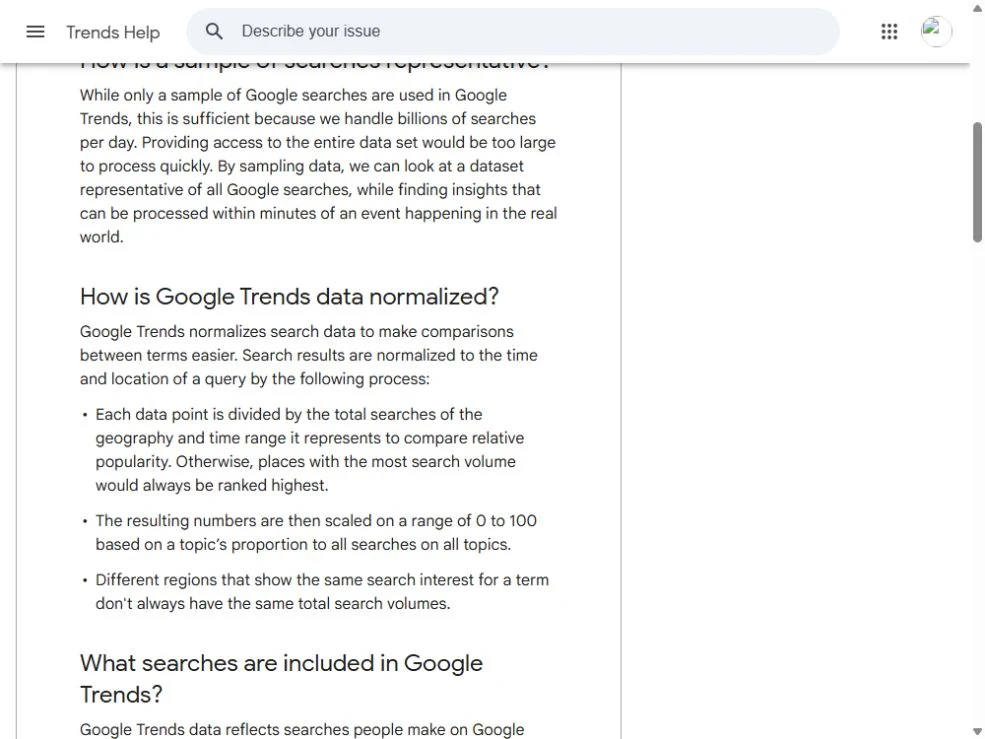
Google Trends can provide another limited signal. Its official explanation describes relative search interest scaled from 0 to 100, not a count of buyers. A rise in searches may justify further investigation, but it does not establish willingness to pay for your specific offer.
Show a representative sample
Make a small example that demonstrates the proposed result. A service sample might show an organized handout alongside fictional rough notes. A digital product sample might include one usable worksheet and its instructions. Choose material that resembles the real task while avoiding private customer information. Label fictional inputs clearly so nobody mistakes the sample for a completed client project.
Ask people to try the sample or explain what they expect it to do. Confusion is useful evidence when it reveals an unclear offer or missing instruction.
Do not interpret every requested feature as a purchase commitment. Ask which part matters most, what the person would use it for, and whether their existing approach already meets the need. A sample should help you learn about the buyer's decision, not only about the design's appearance.
Run a bounded pilot
If early conversations support the idea, offer a small pilot with a defined scope and an honest price. Explain what is included, what is still being tested, and when the customer receives the result. Avoid accepting more work than you can support simply because the experiment attracts interest. Your ability to deliver is part of the business being tested.
A hypothetical pilot might include one handout up to an agreed length, one revision, and a written delivery schedule. The boundaries make the result easier to evaluate.
Measure the full work involved, including questions, file preparation, checking, and follow-up. Record whether the customer understood the package and whether the result solved the stated problem. Paid interest, completion, and useful feedback provide different pieces of evidence; keep them separate in your notes.
Decide what the evidence means
Review the experiment against the assumption you wrote at the beginning. If people recognize the problem but decline the offer, examine fit, timing, trust, and price instead of assuming demand is absent. If they buy but delivery takes too long, improve the scope or process. If the problem rarely occurs, consider another customer group before building around it. Give the experiment an end point so research does not become a permanent substitute for a decision. Choose whether to continue, revise, or stop this version.
Write a brief record of what you learned and the next assumption worth testing. Build the website when you can describe a specific offer supported by evidence, even if the first site is deliberately small.