
Build a Small Test Budget Before Spending on Business Tools
Budget for one business experiment using verified costs, realistic effort, and a spending ceiling. Separate revenue, contribution, time, and continuing expenses.
A startup budget should tell you what the first useful experiment costs and what continuing the business would require. It does not need to begin with a long software shopping list. Start with the work you plan to test, identify the resources it actually needs, and set a limit you can sustain if the experiment earns nothing.
Keep the test budget separate from an income target. A desired monthly revenue figure does not explain why a particular expense is necessary today.
Define the experiment before the spending
Write down the offer, intended customer, and result you want to examine. A freelance document-formatting pilot may need a sample, a way to exchange files, and a clear delivery process. It may not need several paid design tools or a complicated website. Review every proposed purchase against the task it enables, rather than its appeal in a promotional tutorial.
If you cannot identify the task an expense supports, defer it until the need becomes clearer.
Use tools you already have where they can complete the work reliably and are licensed for the intended use. A familiar tool may reduce learning time as well as spending. Check limitations that affect delivery, such as export formats, storage, accessibility, or commercial-use conditions, before relying on it for a client project.
Separate the different kinds of costs
List one-time purchases, recurring charges, and costs triggered by a sale. A domain renewal differs from a project-specific expense; a payment fee differs from a monthly subscription. Separating them helps you see what must be paid even during a quiet month. Also record introductory terms so the first bill does not become your assumed long-term cost.
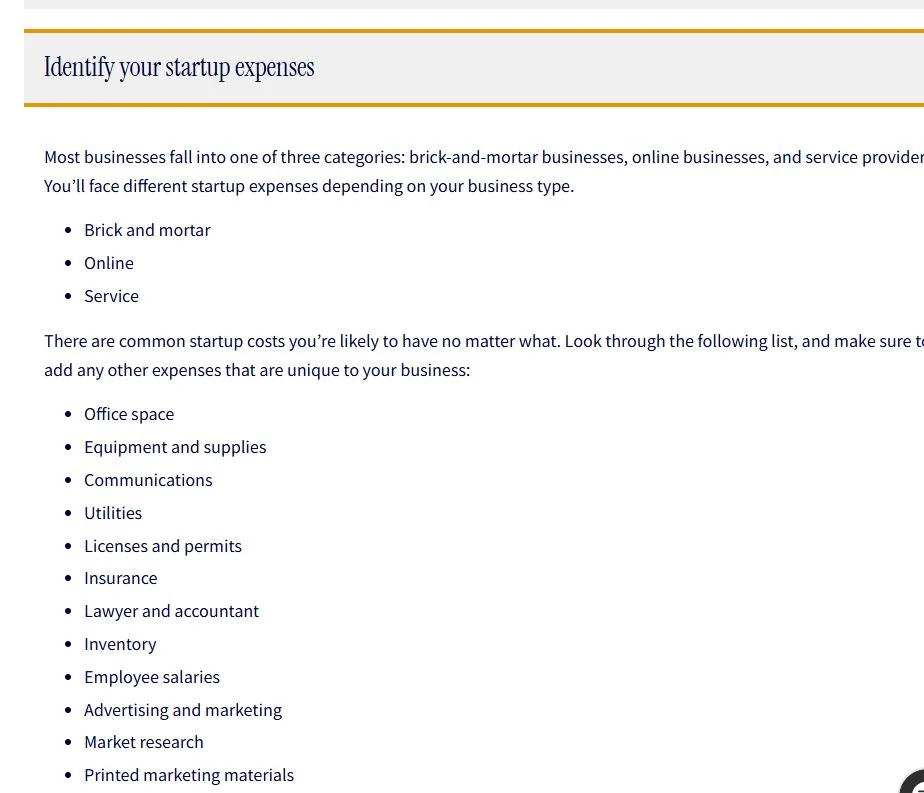
The SBA's startup planning material includes cost and break-even resources. Use them to review the categories relevant to your business, rather than assuming every example expense belongs in your plan.
| Cost type | Hypothetical example | Question to check |
|---|---|---|
| One-time | $40 sample materials | Is this required for the pilot? |
| Recurring | $15 monthly tool | What is the renewal price? |
| Per sale | $5 project expense | Does every sale incur it? |
| Contingency | A chosen reserve | What uncertainty does it cover? |
These amounts are illustrative. Replace them with verified prices and your actual requirements before making a purchase.
Calculate what a sale contributes
Suppose a hypothetical service sells for $120 and has $10 in direct costs per project. That leaves $110 before fixed expenses, owner compensation, and taxes. If monthly fixed expenses total $55, one completed, collected project covers those fixed expenses in this simplified calculation. The figure does not mean the business has provided an adequate income or paid for all your time.
Keep that distinction visible. Covering expenses and paying yourself appropriately are separate questions.
For a product example, assume a $20 selling price and $4 in variable cost. The contribution is $16 per sale. With $160 in fixed expenses, the arithmetic requires ten sales to cover those expenses. Returns, unpaid invoices, taxes, and other relevant costs would change the result, so state what your model includes.
Count your time even when you do not invoice it
Track research, preparation, customer contact, revisions, and administration alongside production work. A service delivered in three hours may require another two hours of questions and file handling. A digital product can require updating and support after creation. Those activities affect whether the offer fits your schedule and whether the price can support the work involved.
Use a practice project or a bounded pilot to gather the first time estimates. Memory tends to miss small tasks scattered through the day.
If the total effort is larger than expected, consider improving the process or narrowing the package before buying automation. A tool can make a step faster, but it cannot by itself resolve an unclear offer or unlimited revision expectations. Identify the bottleneck first and measure it after any change.
Set a spending ceiling and review point
Decide the maximum cash you will put into this experiment and when you will review the evidence. You might choose to evaluate after a fixed period or a set of completed conversations and projects. The right limit depends on your circumstances. It should remain workable if there are no sales, rather than relying on hoped-for revenue to pay the bill.
Write the stop conditions too. For example, pause a subscription if the task it supports is no longer part of the tested offer.
Check cancellations, renewal dates, and any minimum commitment before subscribing. Keep those dates with the expense record so a forgotten trial does not become an ongoing cost. Avoid introducing a new paid tool simply because another tutorial assumes every business needs the same collection of services.
Compare the plan with actual results
Record money received and money paid, then compare them with the assumptions. Track overdue payments separately from collected revenue. Review whether direct costs changed, whether support took longer, and whether a recurring tool was used enough to justify it. These observations help you adjust the business without hiding a weak experiment behind a larger budget.
Seek appropriate help for taxes, benefits implications, or financing decisions that depend on your individual situation. A simple test worksheet does not settle those questions.
Build the worksheet around one offer and the next experiment. Include verified expenses, time assumptions, a spending ceiling, and a review date. You can add detail as the business develops; first make sure the numbers describe work you actually intend to do.